

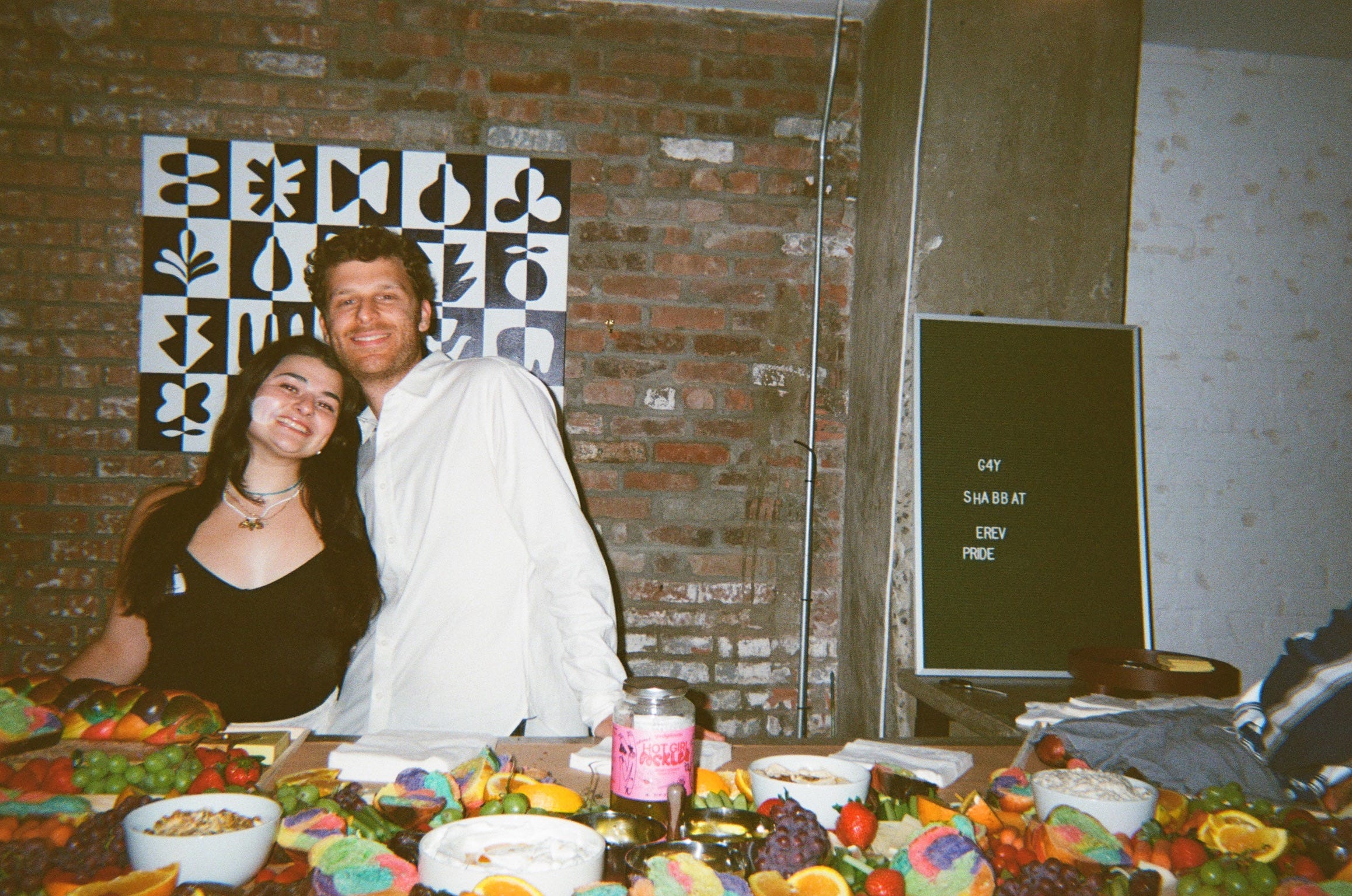
The first Gay Shabbat was not supposed to become anything.
Like many things that turn into something bigger, it started in a cramped NYC living room with about thirty people. Some came through friends, some through Instagram, some through dating apps where we had started quietly recruiting because we weren’t sure how else to find each other. Most of us had never been in a room like that before.
People introduced themselves a little cautiously at first, then more freely as the night went on. Someone stayed late to help clean up without being asked. Someone else said, before leaving, “I didn’t know this existed.”
At the time, neither did we.
We didn’t set out to build a community of thousands. We set out to see if there were other Queer Jews like us, people who felt, in different ways, that the existing spaces available to them were still not enough. Be Jewish here, and Queer there, separately. Be one thing in one room and something else entirely somewhere else.
That split can seem small in theory, but in practice, it is constantly exhausting to mold yourself to the space you’re in. It shows up in synagogue introductions where you edit your life story. In LGBTQ+ spaces where Jewish identity becomes invisible, flattened, or something fearful to share. Or in family gatherings where your queerness is something you carefully decide whether to name at all.
We didn’t have a word for what we were missing at first. Only a shared feeling: that we were always slightly incomplete.
Queer Jewish life is often described as intersectional, which is true, but it’s also often rendered something simpler. Most of us were not looking for something complex or philosophical; we were just looking for a community. For a room where we didn’t have to decide which parts of ourselves were relevant.
Gay Shabbat began on a whim to see whether that kind of room could exist on purpose.
And then something unexpected happened: people asked when the next one was.
We didn’t know there was supposed to be a next one.
But we built it. People kept coming back. Again and again. The same faces, then new faces, then people bringing friends, then people who had just moved to New York, then people who had never met another Queer Jew before, then people who felt emboldened enough to come out.
Somewhere in that repetition of apartment Shabbat dinners, havdalah in Central Park, with dedicated holiday events sprinkled in, the thing we thought was just a gathering started to become an actual structure.
We have seen people meet their closest friends. We watched relationships begin. We watched couples get engaged. When chatting at events and asked how long they’ve known each other, people will say “we met tonight,” even as they speak as though they’ve known each other for a lifetime. We watched people who had spent years feeling like they were the only LGBTQ+ Jew in their orbit walk into a room and visibly exhale.
We also watched something quieter but just as meaningful: people learning how to not only stay, but also return. How to become a part of something not because they were invited once, but because they kept showing up until it started to feel like theirs too.
There is a tendency, especially in conversations about LGBTQ+ and Jewish life, to talk about visibility as the goal and to argue what we need most is to be seen.
But what we’ve learned is that visibility is not enough. You can be seen and still be alone. Sometimes even more so. You can be represented and still feel like you are taken at face value.
What changes people is repetition. The same table. The same Friday night rhythm. The same sense that someone will be there again next event, and the one after that.
As our community grew, we started to understand something else too: that the growth doesn’t only happen in the room itself. It happens in between. More run-ins with familiar faces on the subway platform, newfound running partners, a sudden group who also wants to go to that comedy show you’ve been dying to see.
Belonging, it turns out, is not a single moment, a single day of recognition, or a single month of Pride celebration. It is a pattern.
Three years in, Gay Shabbat is no longer just a living room. It is a network of dinners, gatherings, rituals, and relations spanning thousands of people across New York, California, Tel Aviv and beyond. It brings together people with very different relationships to Judaism and Queerness, some deeply rooted in tradition, others newly reconnecting, others still figuring out what either means for them.
And yet, the core of it hasn’t changed a bit.
It is still about a metaphorical and oftentimes literal table where you don’t have to explain why you are there, or who you are with, or which parts of yourself you are carrying into the room.
If you have ever walked into a room and felt that you didn’t have to translate yourself, you already understand what we are talking about.
But that feeling is not the endpoint, it is actually the beginning of something that has to be nurtured in order to grow.
Pride is about showing up again and becoming part of something that continues whether or not it is convenient.
That is exactly what we have been building with Gay Shabbat. Not a moment, not an event, not a one-time feeling of recognition, but a place you can come back to. And we are nothing without the people who keep coming back to that place we built.
If you haven’t found us yet, consider this our saying hello and reaching out a hand to join. The table is still growing.